
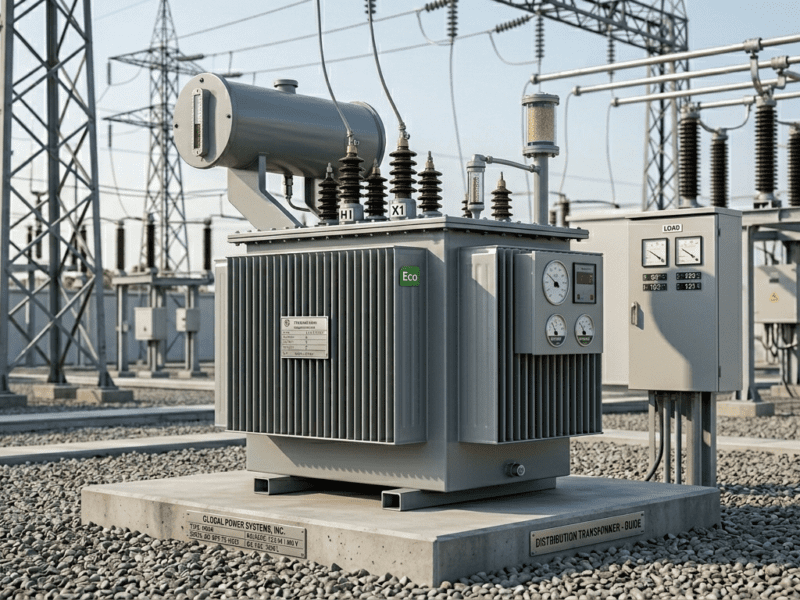
Selecting the right distribution Power transformer for your project is one of the most critical decisions in electrical infrastructure planning. A poorly chosen transformer can lead to energy waste, safety hazards, and costly replacements down the line. This comprehensive guide walks you through every factor you need to consider to make an informed decision.
Understanding Your Power Requirements
Before diving into Power transformer specifications, you must accurately assess your power needs. Start by calculating the total connected load of your facility or project. This includes all equipment, machinery, lighting, and HVAC systems that will draw power. However, the connected load alone isn’t sufficient – you need to determine the actual demand load, which accounts for diversity factors and load utilization patterns.
For industrial applications, the demand factor typically ranges from 0.6 to 0.8, meaning not all equipment runs simultaneously at full capacity. Commercial buildings might see demand factors between 0.5 and 0.7. Understanding these patterns helps you avoid oversizing your transformer, which leads to unnecessary capital expenditure and reduced efficiency at partial loads.
Voltage Ratio and Configuration
The voltage ratio defines how much the transformer steps down or steps up the voltage. In most distribution networks, common primary voltages include 10kV, 35kV, or higher, while secondary voltages typically deliver 400V for industrial use or 230V for residential applications. Your local grid standards dictate the primary voltage available, so verify this with your utility provider.
Beyond the ratio, consider whether you need a three-phase or single-phase transformer. Three-phase transformers are standard for industrial and large commercial applications due to their efficiency and ability to power three-phase motors and equipment. Single-phase units suit residential neighborhoods and small commercial establishments.
Phase configuration also matters. Delta-wye (Dyn11) configurations are common for distribution transformers, providing a neutral point for single-phase loads while maintaining isolation between primary and secondary.
Capacity Rating: Getting It Right
Transformer capacity, measured in kVA (kilovolt-amperes), must accommodate both current loads and future expansion. Many engineers recommend selecting a transformer rated 25-30% above your calculated demand load. This buffer accounts for:
- Future load growth without requiring immediate replacement
- Transient inrush currents from motor starting
- Harmonic loads from variable frequency drives and electronic equipment
- Ambient temperature variations affecting cooling capacity
However, avoid excessive oversizing. Transformers operate most efficiently between 50-75% of their rated capacity. Operating consistently below 40% load wastes energy through core losses that remain constant regardless of loading.
Consider a manufacturing plant with a demand load of 800kVA. A 1000kVA transformer would provide adequate headroom while maintaining efficient operation. Choosing a 2000kVA unit for “extra capacity” would result in poor efficiency and higher no-load losses.
Cooling Methods: Oil-Immersed vs. Dry-Type
The cooling method significantly impacts installation requirements, maintenance, and cost.
Oil-immersed transformers use mineral oil or synthetic fluids for insulation and cooling. They offer excellent heat dissipation, making them suitable for high-capacity applications (typically above 2500kVA). The oil also provides superior arc-quenching properties. However, they require fire safety measures, regular oil testing, and spill containment. Installation must account for the weight of oil-filled units.
Dry-type Power transformers use air for cooling, with windings encapsulated in epoxy resin or cast in insulation materials. They’re inherently safer for indoor installations, require less maintenance, and eliminate fire risks associated with oil. Modern dry-type transformers achieve comparable efficiency to oil-immersed units up to medium capacities. They’re ideal for commercial buildings, underground installations, and environmentally sensitive locations.
Your choice depends on installation environment, local regulations, fire codes, and total cost of ownership considerations.
Energy Efficiency Standards
Modern energy efficiency regulations significantly impact transformer selection. In China, GB20052-2020 standards mandate minimum energy performance levels for distribution transformers. Similar standards exist globally, including DOE standards in the United States and Eco-design requirements in the European Union.
Higher efficiency transformers cost more upfront but deliver substantial lifecycle savings. Consider two 1000kVA transformers: a standard unit with 98% efficiency versus a high-efficiency model at 99%. The 1% difference might seem negligible, but over a 20-year lifespan at average loading, the high-efficiency unit saves enough electricity to offset the price difference several times over.
Pay attention to no-load losses (core losses) and load losses (copper losses). No-load losses are constant whenever the transformer is energized, while load losses vary with the square of the load current. For applications with low load factors, prioritize transformers with low no-load losses.
Installation Environment Considerations
Where you install the transformer affects type selection and long-term performance.
Outdoor installations require weatherproof enclosures, proper drainage, and protection from flooding. Coastal areas demand corrosion-resistant materials or special coatings. In regions with extreme temperatures, consider transformers rated for those conditions – standard units might require derating at high ambient temperatures.
Indoor installations have ventilation requirements. Transformers generate heat during operation, and inadequate ventilation leads to overheating and shortened lifespan. Ensure adequate air circulation or install forced cooling systems. Dry-type transformers are preferred indoors for safety reasons.
Underground or basement installations pose unique challenges, including access for maintenance, moisture control, and fire suppression. Prefabricated compact substations often provide integrated solutions for such scenarios.
Quality and Manufacturer Selection
Not all transformers are created equal. When evaluating manufacturers, consider:
- Manufacturing certifications (ISO 9001, ISO 14001)
- Product certifications (KEMA, CESI, UL listing)
- Quality of core materials (grain-oriented silicon steel vs. amorphous metal)
- Winding material (copper vs. aluminum – copper offers better efficiency and longevity)
- Warranty terms and service support
- Track record in similar applications
Request test reports for short-circuit withstand capability, temperature rise tests, and efficiency measurements. Reputable manufacturers provide type test certificates from independent laboratories.
Conclusion
Choosing the right distribution power transformer requires balancing multiple factors: technical specifications, efficiency standards, installation environment, safety requirements, and total cost of ownership. Take time to analyze your specific needs rather than simply replicating specifications from previous projects. Consult with electrical engineers and transformer specialists when in doubt. The right transformer provides decades of reliable service, while a poor choice leads to ongoing problems and expenses.
Invest in quality upfront, prioritize energy efficiency, and ensure proper installation. Your transformer selection today will impact your operations for the next 20-30 years.