
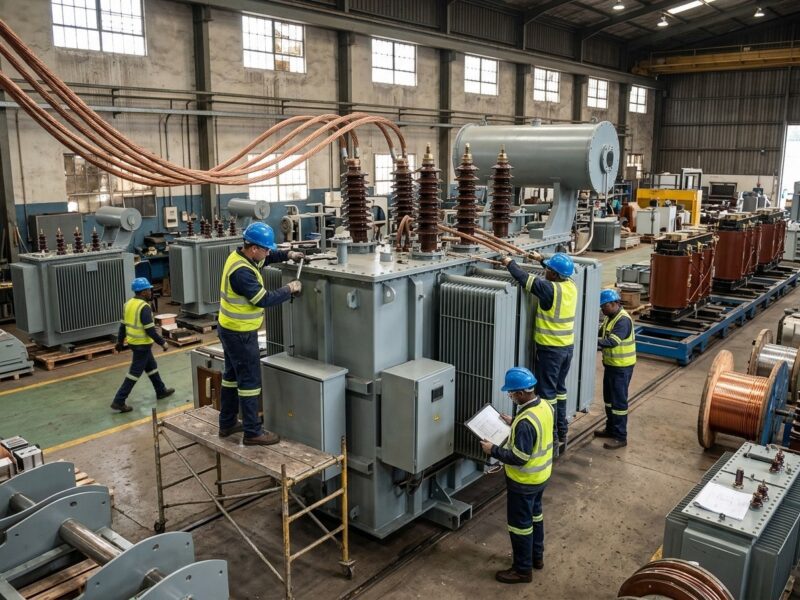
Every time a heavy-duty industrial machine powers up seamlessly, or a quiet residential neighborhood lights up at twilight, an invisible force is doing the heavy lifting. At the very center of this massive electrical web lies the power transformer. Operating silently behind high fences and within utility rooms, these critical devices handle the vital task of changing alternating current (AC) from one voltage level to another.
Whether it is “stepping up” voltage at a massive generation plant to minimize transmission losses over hundreds of miles, or “stepping it down” to safe, usable levels for local machinery and appliances, grid stability completely hinges on these engineering marvels. For grid operators, procurement managers, and infrastructure engineers, understanding the core layout and technological choices behind transformers is key to long-term operational success.
Lifting the Hood: Core Components & How They Work
The operational framework of a power transformer relies on a beautifully elegant concept discovered over a century ago: electromagnetic induction. By avoiding moving parts, it achieves incredibly high mechanical reliability. Its internal system consists of several vital building blocks working in absolute harmony:
- The Iron Core: Built from precisely stacked, high-permeability silicon steel sheets. This layered structure is highly intentional—it cuts down magnetic hysteresis and minimizes eddy current losses, ensuring the magnetic field moves with peak efficiency.
- The Windings (Coils): Formed by wrapping heavy-duty conductors into high-voltage and low-voltage configurations. The exact ratio of these loops dictates how the voltage shifts. The mathematics are rigid: Voltage Ratio = Turns Ratio. For example, in a standard 110kV/10kV substation transformer, the high-voltage winding features exactly 11 times more turns than the low-voltage side.
- The Tank & Protection Devices: A robust structural enclosure designed to protect internal components from moisture and physical wear, equipped with monitoring sensors to capture early signs of stress.
Oil-Immersed vs. Dry-Type Transformers: Navigating Your Options
As a dedicated manufacturer of both major transformer designs, we see firsthand that choosing equipment is never about finding a “one-size-fits-all” answer. Instead, it is about matching your specific environment, budget, and risk tolerance to the right engineering architecture.
Oil-Immersed Transformers
These units feature an internal system completely submerged in specialized insulating oil. The fluid acts as both an excellent dielectric barrier and a highly efficient heat-transfer medium. Because liquid moves heat away much faster than air, oil-filled units are built for high-capacity applications—often scaling easily past 100MVA. They are the standard choice for demanding, high-voltage outdoor infrastructure like regional transmission stations and heavy industrial centers.
Dry-Type Transformers
By completely removing liquid coolants, these systems utilize natural air flow or forced fan cooling. Often sealed in solid epoxy resin, they eliminate any risk of oil leaks or catastrophic fluid fires. This structural fire-safety advantage makes dry-type units the absolute standard for indoor installations, crowded metropolitan networks, underground subways, and modern medical complexes where safety codes leave no room for compromise.
Quick Comparison Guide
| Feature / Parameter | Oil-Immersed Transformers | Dry-Type Transformers |
| Cooling Medium | Insulating Transformer Oil | Air / Forced Fan Ventilation |
| Capacity Threshold | Extremely High (Up to 100MVA+ or more) | Moderate to High (Typically lower than oil units) |
| Installation Environment | Primarily Outdoor Substation Yards | Indoor, High-Density, Underground Spaces |
| Fire Hazard Risk | Requires strict containment & fire walls | Inherently flame-retardant (Self-extinguishing) |
| Primary Application | Power generation, heavy grid transmission | Hospitals, commercial high-rises, subways |
Decoding Key Performance Metrics
When assessing a power transformer’s long-term return on investment, three critical operational thresholds dictate performance:
- Energy Losses: Split cleanly into no-load losses (the continuous baseline energy required to keep the core magnetized) and load losses (the resistive heat generated when current flows through the copper or aluminum windings). Minimizing these values directly lowers operational overhead over a 30-year lifecycle.
- Temperature Rise: Managing internal thermal stress determines the structural lifespan of insulation materials. For instance, maintaining a stable oil temperature rise at or below ≤ 65K under peak load is critical to keeping the system from degrading prematurely.
- Insulation Thermal Rating: Dictates the maximum heat boundaries. Standard Class A materials max out safely at 105°C, whereas high-performance Class H insulation systems can reliably withstand punishing thermal environments up to 180°C—a baseline requirement for rugged dry-type systems.
Industry Note: The global transition toward smart infrastructure is changing how we manage physical grid assets. Passive components are rapidly evolving into intelligent devices.
The Next Era: Smart Diagnostics and Green Efficiency
Modern electrical grids demand more than just brute strength; they require real-time visibility. Today’s premium power transformers come fully integrated with digital monitoring networks. By deploying specialized sensors right inside the system, operators can continuously track oil temperature, fluid expansion, and micro-level partial discharges. Catching these structural shifts early allows operators to pivot away from fixed calendar maintenance and embrace highly predictable, data-driven preventative servicing.
At the same time, hitting strict global carbon reduction targets has pushed eco-friendly engineering to the absolute forefront. High-efficiency systems, such as the advanced S13 oil-immersed series, utilize optimized core geometry and premium steel formulations to slash baseline no-load losses by more than 30% compared to legacy designs. This change does far more than just cut operational spending—it actively reduces grid carbon footprints, helping modern industries meet their sustainability mandates.
Looking for Reliable Power Solutions?
As a premier manufacturer specializing in both premium Oil-Immersed Transformers and high-safety Dry-Type Transformers, we build high-efficiency systems tailored to your project’s unique demands. Contact our engineering consultants today to discuss custom configurations and green energy options.