

When designing a modern power distribution system, safety and efficiency are non-negotiable. This is exactly why 10kV dry-type transformers have become the go-to choice for environments with strict fire and explosion safety codes. From chemical plants and residential grids to major municipal projects, these units offer a robust alternative to traditional oil-immersed transformers.
As a professional manufacturer of both Oil Transformers and Dry Transformers, we have put together this comprehensive guide to help engineers, contractors, and procurement teams understand standard 10kV dry-type transformer capacities and make informed selection decisions.
Key Advantages of 10kV Dry-Type Transformers
Why are industries shifting toward dry-type technology? It comes down to a few critical performance perks:
- Maximum Safety: Free of flammable liquids, these transformers eliminate the risk of oil leaks and dramatically reduce fire hazards.
- Minimal Maintenance: With no cooling oil to monitor, test, or replace, your long-term operational and maintenance workloads drop significantly.
- Strong Environmental Adaptability: Engineered to perform reliably even in harsh conditions, including high humidity and elevated ambient temperatures.
- Low Noise Pollution: Lacking heavy oil cooling circulation systems, they operate much more quietly, making them ideal for indoor and commercial installations.
Standard Capacity Range for 10kV Dry Transformers
To meet diverse power demands across various industries, 10kV dry-type transformers are manufactured in a wide spectrum of standard capacities. Below are the industry-standard ratings (measured in kVA):
| Small-Scale Demand | Medium-Scale Demand | Large-Scale / Industrial Demand |
| * 30 kVA * 50 kVA * 80 kVA * 100 kVA * 125 kVA * 160 kVA | * 200 kVA * 250 kVA * 315 kVA * 400 kVA * 500 kVA * 630 kVA | * 800 kVA * 1000 kVA * 1250 kVA * 1600 kVA * 2000 kVA * 2500 kVA * 3150 kVA |
Key Factors in Sizing Your Transformer
Choosing the right transformer size is a delicate balancing act that directly impacts your bottom line. Oversizing leads to unnecessary upfront costs and no-load losses, while undersizing risks equipment damage and premature failure. Keep these four pillars in mind:
- Load Demand: The transformer must comfortably handle your peak load while leaving a reasonable margin for future facility expansion.
- Power Factor (PF): The actual power factor of your equipment dictates the real-world efficiency of the transformer’s output.
- Operational Efficiency: Transformers hit their peak efficiency at specific load ratios. Sizing your unit to operate within its “sweet spot” reduces energy waste.
- Cost-Effectiveness: Larger capacity means higher initial capital expenditure. The goal is to find the perfect intersection between capability and budget.
How to Calculate the Required Capacity
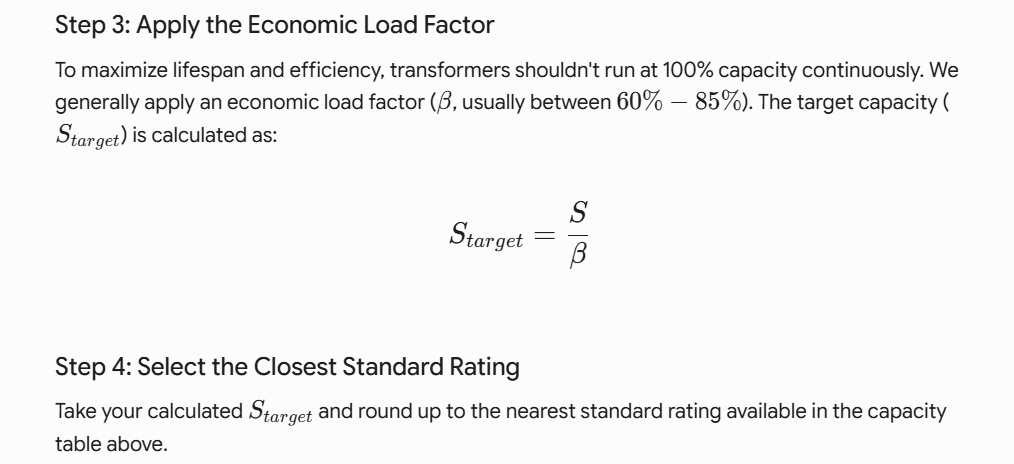
Determining the right capacity involves translating your actual load profile into a standard kVA rating using the economic loading rate. Here is the step-by-step logic our engineering team uses:
Step 1: Calculate Total Active Power (P)
Sum up the active power demands of all electrical equipment intended to run on the system (measured in kW).
Step 2: Account for the Power Factor
Convert active power into apparent power (S, measured in kVA) using the formula:

Need Expert Advice?
Selecting the perfect 10kV dry-type transformer requires a deep understanding of your specific application’s load profile. As a dedicated manufacturer of premium Dry Transformers and Oil Transformers, our engineering team is here to help you calculate, spec, and build the exact solution your project needs.
[Contact our technical sales team today] for custom quotes, detailed datasheets, or factory-direct pricing!