
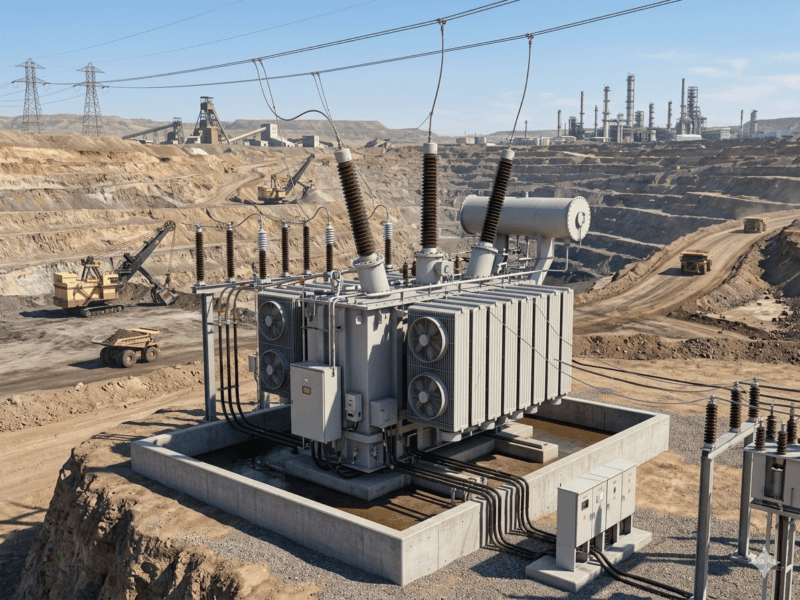
In industrial power distribution systems, the 35kV voltage level occupies a critical position between transmission networks and facility-level distribution. Transformers rated for 35kV primary voltage serve diverse industrial applications, from mining operations to manufacturing complexes. Understanding the specific requirements and advantages of 35kV transformer applications helps engineers design more effective and economical power systems.
The Role of 35kV in Industrial Power Distribution
The 35kV voltage level bridges medium-voltage transmission and distribution. In many countries, particularly China and regions with similar grid standards, 35kV represents a standard sub-transmission voltage, stepping down from higher transmission voltages (110kV, 220kV) to supply industrial facilities and large commercial installations.
This intermediate voltage level offers several advantages for industrial applications. Transmission at 35kV reduces line losses compared to lower voltages, enabling longer distribution distances with acceptable efficiency. The equipment costs remain reasonable – higher than 10kV systems but significantly lower than transmission-class equipment. For facilities with substantial power requirements, 35kV provides an optimal balance between transmission efficiency and equipment economics.
Many industrial facilities receive power at 35kV and perform voltage reduction in stages: first to 10kV for medium-voltage motors and large equipment, then to 400V for general industrial loads. This hierarchical approach optimizes both efficiency and equipment selection.
Typical Industrial Applications
Mining operations frequently rely on 35kV distribution systems. Large mining sites span considerable distances, with power required at extraction equipment, processing facilities, and support infrastructure. The 35kV distribution network delivers power efficiently across the site, with transformers at various locations stepping voltage down for specific loads.
Open-pit mines use 35kV to power large electric shovels, draglines, and crushers. Underground mines employ 35kV distribution to supply ventilation systems, hoists, and processing equipment. The ability to transmit power over distances with acceptable losses makes 35kV ideal for these geographically dispersed operations.
Heavy manufacturing facilities, including steel mills, aluminum smelters, and chemical plants, often require power at the 35kV level. These facilities have enormous power demands – sometimes hundreds of megawatts – that would overwhelm lower-voltage distribution systems. Receiving power at 35kV reduces the current for a given power transfer, enabling smaller conductors and lower losses in the facility’s primary distribution system.
Petrochemical complexes use 35kV transformers throughout their operations. Process units, utilities, and support facilities each require dedicated power supplies. The 35kV distribution system provides flexibility for expansion and redundancy, with transformers positioned strategically throughout the complex.
Cement plants represent another major application. The combination of large motors for grinding mills, kiln drives, and material handling systems creates substantial power demand. 35kV distribution enables efficient power delivery to these large loads while providing convenient voltage transformation for auxiliary systems.
Data centers increasingly consider 35kV supply for large installations. As data center power densities increase and facility sizes grow, medium-voltage distribution at 35kV offers advantages in cable sizing, fault current management, and overall system efficiency.
Design Considerations for 35kV Transformers
Transformers for 35kV applications require specific design considerations beyond standard distribution transformers.
The higher primary voltage increases insulation requirements. Windings, bushings, and internal clearances must accommodate the increased voltage stress. While 35kV remains well below transmission-class voltages, the insulation requirements are significantly more demanding than 10kV equipment.
Basic impulse level (BIL) ratings for 35kV transformers typically range from 170-200kV, reflecting the need to withstand switching and lightning surges. Proper insulation coordination with upstream protective devices ensures transformer protection during transient events.
Short-circuit withstand capability becomes increasingly important at higher voltages. 35kV systems can deliver substantial fault currents, and transformers must survive through-fault events without damage. Winding bracing, lead supports, and internal structures must handle the mechanical forces generated during faults.
Connection configurations for 35kV transformers typically use delta-wye (Dyn11) arrangements. The delta primary provides isolation from ground faults on the 35kV system, while the wye secondary offers a neutral point for grounding and single-phase loads. Other configurations serve special applications.
Capacity ranges for 35kV industrial transformers span from a few MVA to tens of MVA. Smaller units (2-5 MVA) serve individual process units or buildings. Larger units (10-20 MVA) supply main facility power. Multiple transformers in parallel provide redundancy and capacity for facilities with critical loads.
Installation and Protection Requirements
Installing 35kV transformers requires attention to several critical factors.
Foundation design must accommodate the transformer’s weight, which increases substantially with capacity. Large oil-immersed transformers may require reinforced concrete foundations with oil containment provisions. The foundation must also support any accessories, cooling equipment, and cable terminations.
Clearance requirements at 35kV exceed those for lower voltages. Phase-to-phase and phase-to-ground clearances must meet applicable standards for safe operation and maintenance access. Safety clearances around energized equipment protect personnel during routine operations and emergency response.
Protection systems for 35kV transformers include differential protection, overcurrent protection, gas protection (for oil-immersed units), and temperature monitoring. Differential protection detects internal faults by comparing current entering and leaving the transformer. Overcurrent protection handles external faults and overload conditions. Gas protection (Buchholz relay) detects internal arcing and incipient faults in oil-immersed transformers.
Surge protection diverts lightning and switching surges away from the transformer. Surge arresters connected at the transformer terminals limit voltage transients that could damage insulation. Proper grounding ensures that surge currents flow safely to earth.
Coordination with upstream protection devices ensures that faults are cleared quickly while minimizing unnecessary outages. Time-current coordination studies determine appropriate protection settings for the specific installation.
Maintenance Strategies for Industrial Applications
Industrial facilities typically implement comprehensive maintenance programs for 35kV transformers, recognizing the critical role these assets play in facility operations.
For oil-immersed transformers, regular oil analysis provides early warning of developing problems. Dissolved gas analysis (DGA) detects incipient faults by identifying characteristic gases produced by different fault types. Moisture analysis monitors insulation condition, as water contamination accelerates aging. Oil quality tests assess dielectric strength and acidity.
Routine inspections identify external issues: oil leaks, corrosion, damaged bushings, and cooling system problems. Thermal imaging detects hot spots indicating poor connections or internal problems. Infrared surveys conducted under load reveal issues invisible during de-energized inspections.
Electrical tests conducted periodically assess insulation condition. Insulation resistance testing, power factor testing, and turns ratio testing provide quantitative data on transformer health. Comparing results over time reveals trends indicating degradation.
Maintenance intervals depend on operating conditions and criticality. Transformers in harsh environments or critical applications require more frequent attention. Condition-based maintenance programs use test and inspection results to optimize maintenance timing, performing work when needed rather than on arbitrary schedules.
Efficiency and Economic Optimization
Selecting 35kV transformers involves economic optimization considering both initial cost and lifetime operating costs.
Efficiency at the 35kV level is particularly important because these transformers often supply substantial loads continuously. A 10 MVA transformer operating at 70% load factor with efficiency of 98.5% loses approximately 1,050 kW continuously. Improving efficiency to 99% reduces losses to 700 kW – a 350 kW improvement that accumulates to over 3 million kWh annually.
The economic impact is substantial. Even with moderate electricity costs, annual savings from efficiency improvements can reach tens of thousands of dollars. Over a transformer’s 25-30 year life, the present value of these savings often justifies investing in high-efficiency designs.
Energy efficiency standards applicable to distribution transformers typically don’t cover the larger capacities common at 35kV, but the economic case for efficiency remains compelling. Many industrial facilities specify efficiency requirements beyond minimum standards, recognizing the long-term value of reduced losses.
Amorphous alloy cores, while more common in smaller distribution transformers, can also benefit 35kV applications. The dramatic reduction in no-load losses particularly benefits installations with variable loading or significant periods of reduced operation.
Integration with Facility Power Systems
35kV transformers must integrate effectively with overall facility power systems.
System grounding practices affect transformer specifications. The grounding method on the secondary side (solidly grounded, resistance grounded, or ungrounded) influences transformer design and protection requirements. Coordinate transformer specifications with overall system grounding philosophy.
Parallel operation of multiple transformers requires attention to impedance matching, voltage ratio tolerance, and phase relationship. Transformers intended for parallel operation must have compatible characteristics to ensure proper load sharing.
Voltage regulation requirements vary by application. Facilities with sensitive equipment might require on-load tap changers (OLTC) to maintain voltage within tight tolerances. Simpler installations might use off-circuit tap changers adjusted manually during de-energized conditions.
Harmonic mitigation might be necessary for facilities with significant non-linear loads. Variable frequency drives, arc furnaces, and other harmonic sources can cause overheating in standard transformers. K-rated transformers or oversized units handle harmonic currents without excessive heating.
Case Studies
A copper mining operation in western China installed 35kV distribution to power equipment across a 15-square-kilometer site. The distribution network feeds transformers at the concentrator (2×12.5 MVA), mine headframe (2×8 MVA), and various auxiliary facilities (multiple 2-5 MVA units). The 35kV system reduces cable costs compared to 10kV distribution while maintaining acceptable losses across the site’s long distances.
A petrochemical complex on China’s east coast receives power at 110kV and steps down to 35kV for internal distribution. The 35kV network supplies over 30 transformers ranging from 2 MVA to 16 MVA, each serving specific process units. The modular approach allows individual units to be shut down for maintenance without affecting the entire facility. Redundant transformers at critical units ensure continuous operation.
A data center campus uses 35kV supply to reduce copper requirements and improve efficiency in the primary distribution system. The facility operates four 20 MVA transformers, each feeding independent power trains. The N+1 redundancy configuration allows maintenance and failures without affecting critical IT loads. The 35kV supply also simplifies utility interconnection compared to multiple lower-voltage services.
Future Trends
35kV transformer applications continue evolving with changing industrial requirements.
Renewable energy integration creates new applications for 35kV transformers. Wind farms and solar installations often collect power at 35kV before transformation to transmission voltages. These applications require transformers designed for bidirectional power flow and variable loading patterns.
Smart grid technologies influence transformer specifications. Monitoring systems, communications interfaces, and advanced protection functions add intelligence to traditionally passive equipment. These features enable condition-based maintenance, automated demand response, and improved reliability.
Efficiency requirements continue tightening. Even without mandatory standards for larger transformers, customer specifications increasingly demand efficiency levels once considered premium. Manufacturers respond with improved designs and materials.
Digitalization affects transformer specifications and operation. Sensors, monitoring systems, and analytics platforms provide unprecedented visibility into transformer condition and performance. This information enables optimized operation and maintenance strategies.
Conclusion
35kV transformers serve critical roles in industrial power distribution, balancing transmission efficiency with equipment economics for medium to large facilities. Successful application requires attention to voltage level-specific design considerations, protection requirements, and integration with overall power system design.
The selection process should consider total cost of ownership, including efficiency losses over the transformer’s lifespan. Investing in high-efficiency designs typically delivers substantial long-term savings, particularly for continuously operated industrial facilities.
Proper installation, protection, and maintenance ensure reliable operation over decades of service. Condition monitoring and predictive maintenance strategies optimize maintenance timing while minimizing unplanned outages.
As industrial facilities grow larger and more power-dense, 35kV transformer applications will continue expanding. Engineers who understand the unique requirements and opportunities at this voltage level will design more effective, efficient, and reliable power systems for industrial operations.