
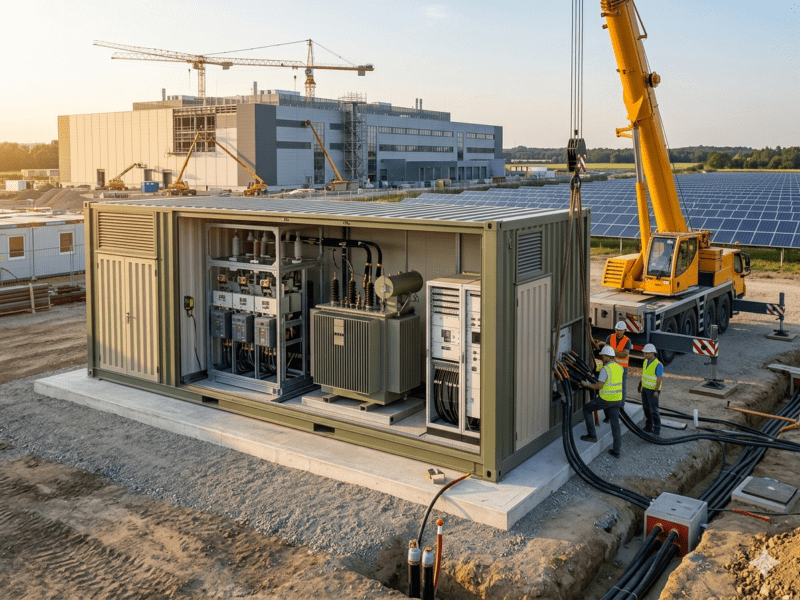
In an era where speed-to-power determines project success, prefabricated substations have emerged as a transformative solution for electrical infrastructure. These self-contained, factory-built power systems slash installation times from months to weeks while ensuring consistent quality and performance. Understanding prefabricated substation technology helps engineers and project managers make informed decisions for applications demanding rapid deployment.
What is a Prefabricated Substation?
A prefabricated substation, also known as a compact substation, packaged substation, or containerized substation, is a complete power transformation and distribution system assembled and tested at the factory, then transported to the installation site as an integrated unit.
Unlike conventional substations assembled on-site from individual components, prefabricated units arrive with transformers, switchgear, protection systems, and auxiliary equipment already installed and interconnected. The entire system undergoes factory testing before shipment, ensuring all components work together correctly.
The enclosure protects internal equipment from environmental conditions while providing safety barriers for personnel. Depending on the application, enclosures might be steel containers, purpose-built housings, or even underground vaults. Climate control systems maintain appropriate operating temperatures regardless of external conditions.
Standard configurations include high-voltage incoming sections, transformer compartments, and low-voltage distribution sections. The transformer steps down incoming voltage (typically 10kV, 35kV, or higher) to utilization voltage (400V for most industrial and commercial applications). Switchgear on both high and low voltage sides provides protection and isolation capability.
Advantages Over Conventional Construction
The benefits of prefabricated substations extend beyond simple time savings.
Rapid deployment represents the most obvious advantage. A prefabricated substation can be operational within days of delivery, compared to months for conventional substation construction. The time savings come from eliminating on-site assembly, reducing civil construction, and streamlining commissioning. For projects with tight schedules or emergency power needs, this speed is invaluable.
Factory-controlled quality ensures consistent results. In a manufacturing facility, workers operate in controlled conditions with proper tools, equipment, and supervision. Quality control processes catch issues before products leave the factory. This contrasts with on-site construction, where weather, site conditions, and varying workforce skill levels affect quality.
Cost predictability improves budget management. Prefabricated substations have fixed prices determined at quotation. Conventional substations face cost uncertainty from construction delays, weather impacts, material price fluctuations, and change orders. The lump-sum pricing of prefabricated units eliminates many budget risks.
Space efficiency enables installation in constrained locations. Prefabricated designs optimize equipment layouts for compact footprints. Where a conventional substation might require significant land area, a prefabricated unit occupies a fraction of the space. This matters in urban environments, industrial facilities with limited expansion area, and temporary installations.
Reduced environmental impact during installation. On-site construction generates noise, dust, traffic, and waste. Prefabricated substations require minimal on-site work – primarily foundation placement, cable connections, and commissioning. This reduced construction activity benefits sensitive locations like hospitals, schools, and residential areas.
Flexibility for future modifications. Many prefabricated substations are designed for expansion or relocation. Additional units can connect to increase capacity. If power needs change, the substation can be moved to a new location or repurposed. This flexibility has value in dynamic operational environments.
Typical Applications
Prefabricated substations serve diverse applications across industries and infrastructure.
Construction sites use prefabricated substations for temporary power supply. During major construction projects, substantial power is needed for equipment, lighting, and site facilities. A prefabricated substation can be installed quickly at project start and removed or relocated when construction completes. The temporary nature of the power need makes conventional substation construction impractical.
Mining operations benefit from prefabricated solutions for several reasons. Mine sites often expand or shift as extraction progresses, requiring power supply to move accordingly. The harsh conditions at mines make factory-built equipment more reliable than field-assembled alternatives. The speed of deployment minimizes production delays when establishing new mining areas.
Industrial facility expansions use prefabricated substations when adding production lines or new buildings. Rather than modifying existing electrical infrastructure, a new prefabricated substation provides dedicated power for the expansion. This approach avoids disrupting ongoing operations during construction.
Renewable energy installations increasingly use prefabricated collector substations. Wind farms and solar installations need to step up voltage from individual turbines or inverters for transmission to the grid. Prefabricated substations at the collection point reduce installation time and ensure consistent protection and control.
Commercial developments, including shopping centers, office parks, and mixed-use developments, often use prefabricated substations for their power infrastructure. The reduced construction time and space requirements fit well with commercial development schedules and land economics.
Remote locations without existing electrical infrastructure benefit from complete, self-contained power solutions. Off-grid mining camps, remote industrial facilities, and developing area electrification projects use prefabricated substations as complete power distribution solutions.
Data centers employ prefabricated substations for rapid deployment of new capacity. As data center power demands grow quickly with computing needs, prefabricated solutions enable faster capacity additions than conventional construction timelines allow.
Design Configurations
Prefabricated substations come in various configurations to suit different applications.
The basic configuration includes a high-voltage incoming section, transformer compartment, and low-voltage distribution section in a single enclosure. High-voltage switchgear (ring main units, load break switches, or circuit breakers) provides incoming protection and isolation. The transformer compartment houses the distribution transformer. Low-voltage distribution includes main breaker, feeder breakers, and protection systems.
Larger capacity installations might use a two-piece design with separate high-voltage and low-voltage sections connected on-site. This approach handles transformers too large for single-unit transport while maintaining the benefits of factory assembly.
Underground designs place the entire substation below grade, with only access covers and ventilation visible at the surface. These designs suit urban environments where surface space is limited or where aesthetics require invisible infrastructure. Underground installation adds civil complexity but delivers maximum space efficiency.
Pad-mounted designs sit on a concrete surface slab, with equipment enclosed in weatherproof housing. These are common for commercial and residential applications where above-ground installation is acceptable but a full substation yard would be excessive.
Containerized designs use standard shipping container dimensions for the enclosure. This approach optimizes transportation logistics, as container-handling equipment exists at ports and construction sites worldwide. The standardized dimensions also simplify planning for space and access.
Technical Specifications and Options
Understanding specification options helps select the right prefabricated substation for each application.
Transformer capacity ranges from small distribution sizes (100-500kVA) to medium-power applications (1000-2500kVA). Custom designs handle larger capacities, though transportation constraints limit maximum sizes for single units.
Voltage transformation typically steps down from medium-voltage distribution (10kV, 35kV, or similar) to low-voltage utilization (400V or similar). Custom voltage ratios suit specific applications.
High-voltage protection options include load break switches for simple applications, ring main units for loop-fed systems, or full circuit breakers for applications requiring sophisticated protection. The choice depends on system configuration and protection requirements.
Low-voltage distribution configurations vary based on load requirements. Options include main circuit breakers with multiple feeder breakers, metering provisions, automatic transfer switches for dual-supply systems, and power quality equipment.
Transformer types can be oil-immersed or dry-type. Oil-immersed transformers offer cost advantages and robust overload capability, while dry-type transformers suit installations where fire safety or environmental concerns prohibit oil-filled equipment.
Protection and control systems range from basic overcurrent protection to comprehensive automation. Advanced options include SCADA interfaces, remote monitoring, automatic protection schemes, and power quality monitoring.
Climate control maintains acceptable operating temperatures regardless of external conditions. Options include passive ventilation, forced air cooling, heating for cold climates, and air conditioning for extreme conditions.
Installation Process and Requirements
Installing a prefabricated substation is simpler than conventional substation construction but requires proper planning and execution.
Foundation preparation precedes delivery. The foundation must support the substation’s weight (often 10-30 tons or more depending on size) and provide a level surface for installation. Foundation design considers soil conditions, drainage, and cable entry points. For underground designs, foundation work includes excavation and structural support.
Delivery coordination ensures the substation arrives when site preparation is complete. Transportation planning addresses route restrictions, lifting equipment requirements, and site access. Large substations might require special transport permits or temporary road modifications.
Setting the substation in place requires lifting equipment sized for the unit’s weight and dimensions. Crane capacity must exceed the substation weight with appropriate safety margins. Setting accuracy affects cable connection ease and overall installation quality.
Cable connections on both high-voltage and low-voltage sides complete the electrical installation. Factory-installed cable terminations or bus connections simplify this work. Proper termination techniques ensure reliable, safe connections.
Grounding provides safety and proper equipment operation. The substation must connect to a grounding system meeting applicable standards. Ground resistance measurements verify adequate grounding.
Commissioning verifies proper operation before energization. Commissioning checks include insulation resistance tests, protection system verification, correct operation of switches and breakers, and proper sequencing for automated functions.
The entire installation process typically completes in days to weeks, compared to months for conventional substation construction.
Quality Assurance and Testing
Factory testing provides assurance that prefabricated substations will perform correctly upon installation.
Type testing establishes baseline performance for design configurations. Type tests include temperature rise tests, short-circuit withstand tests, and dielectric tests. Once a design passes type testing, subsequent units of the same design require only routine testing.
Routine testing verifies each production unit meets specifications. Routine tests include insulation resistance, winding resistance, voltage ratio, no-load and load loss measurements, and functional testing of protection and control systems.
Factory acceptance testing (FAT) allows customers to witness testing of their specific units. FAT typically includes all routine tests plus additional checks specified by the customer. Witness testing provides confidence that the equipment meets requirements.
Pre-shipment inspection confirms the substation is ready for delivery. This inspection verifies completeness, proper packaging for transportation, and documentation.
Upon installation, site acceptance testing confirms the substation performs correctly after transportation and installation. Site tests typically repeat key routine tests to verify no damage occurred during transport.
Maintenance Considerations
While prefabricated substations simplify installation, they still require maintenance for reliable long-term operation.
Routine inspections identify developing issues before they cause failures. Visual inspections check for damage, corrosion, oil leaks (for oil-immersed transformers), and unusual conditions. Thermal imaging identifies hot spots on connections and equipment.
Transformer maintenance follows standard practices for the transformer type. Oil-immersed transformers require oil sampling and analysis, while dry-type transformers need periodic cleaning and connection checks.
Switchgear maintenance includes exercising switches and breakers to ensure proper operation, inspecting contacts for wear or damage, and testing protection systems.
Cooling system maintenance ensures adequate temperature control. Filters on forced-air systems require cleaning or replacement. Refrigerant levels in air conditioning systems need periodic checking.
Documentation provided with the substation includes maintenance schedules specific to the equipment installed. Following manufacturer recommendations maintains warranty coverage and ensures reliable operation.
Economic Analysis
Evaluating prefabricated substations against conventional alternatives requires total cost analysis.
Initial equipment cost for prefabricated substations is often higher than component costs for conventional substations. The factory integration, enclosure, and testing add cost beyond individual component prices.
Installation cost is dramatically lower. Foundation work, cable connections, and commissioning for prefabricated units cost a fraction of the civil construction, equipment setting, interconnection, and testing required for conventional substations.
Project timeline reduction has economic value beyond direct cost savings. Faster power availability enables earlier revenue generation, reduced construction financing costs, and faster project payback.
Quality-related savings come from reduced commissioning issues, fewer warranty claims, and longer equipment life. Factory-controlled construction delivers more consistent quality than field assembly.
Operational cost differences between prefabricated and conventional substations are minimal for equivalent equipment. The transformer efficiency, protection system capabilities, and reliability are similar regardless of installation method.
Total lifecycle cost analysis often favors prefabricated substations despite higher equipment prices. The time savings, quality benefits, and reduced construction risk frequently outweigh the equipment cost premium.
Future Trends
Prefabricated substation technology continues evolving.
Digital integration adds intelligence to traditionally passive equipment. Modern prefabricated substations include monitoring systems, communication interfaces, and analytics capabilities. This intelligence enables predictive maintenance, remote operation, and integration with smart grid systems.
Modular designs allow capacity scaling. Rather than replacing entire substations when power needs grow, modular systems allow adding capacity units. This flexibility reduces stranded investment and enables growth matching.
Sustainable features address environmental concerns. Options include high-efficiency transformers, environmentally-friendly insulation fluids, solar-powered auxiliary systems, and designs optimized for end-of-life recycling.
Standardization across manufacturers improves interchangeability. While custom designs remain common, industry standards for dimensions, interfaces, and performance allow more options for sourcing and replacement.
Conclusion
Prefabricated substations offer compelling advantages for applications requiring rapid deployment, consistent quality, and predictable costs. The technology transforms power infrastructure installation from a construction project into an equipment delivery, compressing timelines from months to weeks.
For construction sites, mining operations, industrial expansions, renewable energy installations, and any application where speed matters, prefabricated substations provide an efficient solution. The economic benefits extend beyond simple cost comparison to include time value, risk reduction, and operational reliability.
As digital integration, modular designs, and sustainability features advance, prefabricated substations will serve an expanding range of applications. Engineers and project managers who understand this technology can leverage its advantages for more successful projects.
The future of power infrastructure increasingly runs on speed, flexibility, and intelligence – all qualities that prefabricated substations deliver.