
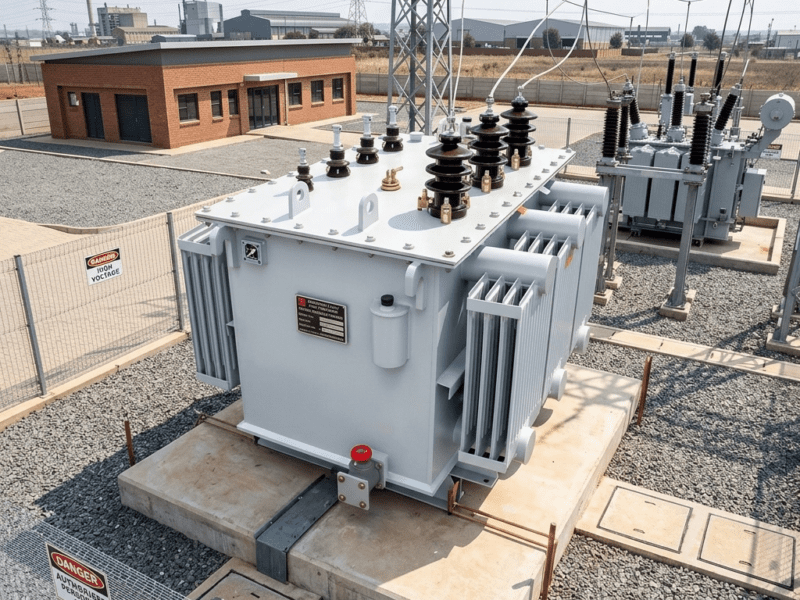
In the pursuit of energy efficiency, amorphous alloy Distribution transformers represent one of the most significant technological advances in the transformer industry. These transformers achieve remarkable reductions in no-load losses – up to 70% compared to conventional designs – making them increasingly attractive for applications where energy conservation matters. This article explains the technology behind amorphous alloy transformers and their practical benefits.
What is Amorphous Alloy?
Amorphous alloy, also called metallic glass, is a material with no crystalline structure. Most metals have organized crystal structures where atoms arrange in regular, repeating patterns. Amorphous alloys freeze atoms in random positions, similar to glass, hence the name metallic glass.
This unique structure gives amorphous alloys extraordinary magnetic properties. When used as transformer core material, the random atomic arrangement eliminates the magnetic domain boundaries that cause energy loss in conventional silicon steel cores. The material can be magnetized and demagnetized with minimal energy expenditure, dramatically reducing core losses.
The most common amorphous alloy for transformer applications is iron-based, containing iron, boron, and silicon (Fe-B-Si). The material is produced by rapidly cooling molten metal at rates exceeding one million degrees per second, preventing crystal formation. The resulting material is a thin ribbon, typically 0.025-0.030mm thick, with a metallic luster.
The development of amorphous alloys for Distribution transformers began in the 1970s, with commercial production starting in the 1980s. Early applications were limited by high material costs and manufacturing challenges, but decades of development have made amorphous alloy transformers increasingly competitive.
Why Amorphous Cores Reduce Losses
Understanding transformer core losses requires examining the physics of magnetization.
In conventional grain-oriented silicon steel, atoms arrange in crystals with magnetic domains. When an alternating current magnetizes the core, domain walls move, and domains rotate to align with the magnetic field. This movement encounters resistance, dissipating energy as heat. These are hysteresis losses.
Additionally, the changing magnetic flux induces circulating currents (eddy currents) within the core material. These currents also dissipate energy as heat. Eddy current losses increase with material thickness and magnetic flux frequency.
Amorphous alloys reduce both loss types dramatically:
The random atomic structure means no crystal boundaries and very few distinct magnetic domains. Magnetization occurs by rotation of the overall magnetic moment rather than domain wall movement. This process requires far less energy, reducing hysteresis losses by approximately 80% compared to silicon steel.
The extremely thin ribbon structure (0.025mm versus 0.23-0.35mm for silicon steel) minimizes eddy current paths. The thin cross-section dramatically reduces eddy current losses. The material’s high electrical resistivity further suppresses eddy currents.
The combined effect reduces no-load losses by 60-75% compared to Distribution transformers using conventional silicon steel cores. This isn’t a marginal improvement – it’s a fundamental transformation in transformer efficiency.
Comparing Losses: Amorphous vs. Conventional
The dramatic difference in no-load losses becomes clear through direct comparison.
Consider a 1000kVA distribution transformer operating at 10kV. A conventional design using high-grade grain-oriented silicon steel might have no-load losses around 1100-1300 watts. An equivalent amorphous alloy transformer achieves no-load losses of 300-450 watts – a reduction of approximately 70%.
Load losses show less difference between technologies. Both types use copper or aluminum windings with similar resistance characteristics. Amorphous transformers might have slightly higher load losses due to different core geometries and winding arrangements, but the difference is typically minimal, often less than 5%.
At typical operating loads of 40-60% of rated capacity, total losses in amorphous Distribution transformers are 25-40% lower than conventional designs. The exact figure depends on the load factor – at lower loads, where no-load losses dominate, the savings are greater.
Over a transformer’s 20-30 year lifespan, these savings accumulate dramatically. A single 1000kVA amorphous transformer can save 200,000-400,000 kWh compared to a conventional unit, depending on loading patterns. At industrial electricity rates, the savings often exceed the transformer’s purchase price.
Manufacturing Challenges and Solutions
Amorphous alloy transformers require specialized manufacturing processes.
The thin amorphous ribbon is fragile and difficult to handle compared to silicon steel sheets. Conventional core assembly processes that work for silicon steel would damage amorphous ribbons. Manufacturers developed specialized winding and cutting equipment to handle the material without causing damage.
The thinness of amorphous ribbon affects core geometry. To achieve adequate cross-sectional area for magnetic flux, amorphous cores require many more laminations than silicon steel cores. This affects core dimensions and manufacturing time.
Amorphous cores are typically assembled first, then the coils are wound around them or the core is opened to accept pre-wound coils. This differs from conventional Distribution transformers where cores can be easily disassembled and reassembled around pre-formed coils. The manufacturing sequence affects production efficiency and cost.
Annealing is critical for amorphous cores. The material requires precise heat treatment after forming to optimize magnetic properties. This annealing process adds a manufacturing step not required for conventional silicon steel cores.
These manufacturing challenges historically made amorphous transformers significantly more expensive. However, manufacturing technology has matured, and production volumes have increased. Today, amorphous transformers cost 15-30% more than conventional high-efficiency transformers, down from 50-100% premiums in earlier years.
Economic Analysis: When Does Amorphous Make Sense?
The economic case for amorphous alloy transformers depends on several factors.
Energy costs matter enormously. Higher electricity prices make efficiency investments more attractive. Regions with high industrial electricity rates see shorter payback periods for amorphous transformers.
Load factor is equally important. Amorphous transformers provide maximum benefit when no-load losses constitute a large portion of total losses – that is, at low load factors. Applications with light loading or significant idle periods benefit most.
Consider a transformer operating at 30% average load factor. No-load losses dominate total losses, and the 70% reduction in no-load losses translates to 50% or greater reduction in total losses. The economic case is compelling.
Conversely, a transformer operating continuously at 90% load factor sees less benefit. Load losses constitute the majority of total losses, and amorphous technology provides limited improvement there. The efficiency gain might be 15-20%, reducing but not eliminating the economic advantage.
Operating hours affect the calculation. Transformers energized 24/7 benefit from reduced no-load losses every hour of the year. Transformers with limited operating hours (seasonal facilities, backup installations) see less benefit from reduced no-load losses.
Simple payback period calculations help evaluate the investment:
Payback period = (Additional cost of amorphous transformer) / (Annual energy savings × Electricity cost)
For many applications, payback periods range from 4-8 years. Considering 20-30 year transformer lifespans, the long-term economics strongly favor amorphous technology when load factors are moderate to low.
Application Scenarios
Amorphous alloy transformers excel in specific applications:
Residential distribution networks typically operate at low load factors, often 20-40%. Transformers are energized continuously, and no-load losses represent a large portion of energy waste. Amorphous transformers in residential areas deliver maximum benefit, helping utilities reduce distribution losses and meet efficiency mandates.
Commercial buildings with predictable daily load cycles also benefit. Office buildings, retail centers, and educational facilities see significant load variations between occupied and unoccupied hours. During low-load periods (nights, weekends, holidays), amorphous transformers dramatically reduce energy waste.
Renewable energy installations often use amorphous transformers for similar reasons. Wind farms and solar installations have variable generation patterns. Distribution Transformers connecting these facilities to the grid may operate at low load factors for extended periods, making low no-load losses valuable.
Data centers represent an emerging application. These facilities operate 24/7 but often maintain significant spare capacity for redundancy. Transformers sized for peak capacity may operate well below rating most of the time. Amorphous transformers reduce energy waste in this critical infrastructure.
Rural electrification projects benefit from amorphous technology. Long distribution lines serving scattered loads often have low load factors. Reducing transformer losses helps extend service to remote areas while minimizing infrastructure costs.
Limitations and Considerations
Despite their advantages, amorphous alloy transformers have limitations to consider.
Higher initial cost remains a barrier for some applications, particularly in price-sensitive markets. While lifecycle economics favor amorphous technology, the higher upfront investment requires capital availability and long-term perspective.
The fragile nature of amorphous ribbon requires careful handling during transportation and installation. While well-designed transformers adequately protect the core, the material remains more vulnerable than silicon steel to mechanical shock.
Amorphous cores are sensitive to mechanical stress. Clamping forces, vibration, and external stresses can degrade magnetic properties. Distribution Transformers must be designed and installed to minimize stress on the core.
Some users report higher audible noise from amorphous Distribution transformers. The material’s magnetostriction characteristics differ from silicon steel, potentially producing different sound profiles. Modern designs address this through optimized core construction and damping measures.
At very high load factors, the efficiency advantage of amorphous technology diminishes. Applications with consistently high loading might achieve similar efficiency with premium silicon steel cores at lower cost.
Future Developments
Amorphous alloy technology continues evolving.
New alloy compositions under development promise even lower losses. Researchers are exploring additions of cobalt, nickel, and other elements to optimize magnetic properties for specific applications.
Improved manufacturing processes aim to reduce production costs further. Continuous annealing, automated core winding, and advanced quality control systems are making amorphous transformers more competitive with conventional designs.
Hybrid designs combining amorphous and silicon steel in different core sections aim to optimize cost and performance. These designs might achieve most of the efficiency benefit at lower cost than pure amorphous cores.
Recycling processes for amorphous materials are being developed. As more amorphous transformers reach end-of-life, sustainable disposal and material recovery become important considerations.
Making the Decision
Should you choose amorphous alloy transformers? Consider these questions:
What is your typical load factor? Below 50%, amorphous transformers deliver maximum benefit.
What are your electricity costs? Higher rates improve the economic case for efficiency investments.
How long will the transformer operate? Longer lifespans mean greater accumulated savings.
What is your capital availability? Higher upfront costs require budget flexibility.
What efficiency standards apply? Amorphous transformers easily meet the most stringent efficiency requirements, including GB20052-2020 Grade 1.
For most applications with moderate to low load factors and electricity costs above average, amorphous alloy transformers represent the optimal choice. The technology has matured, costs have decreased, and the efficiency benefits are undeniable. As energy costs rise and efficiency standards tighten, amorphous Distribution transformers will likely become the standard rather than the exception.